
Introduction
Welcome back to Laboratory. This week we turn to Washington, where the United States has unveiled its most sweeping AI initiative to date: the Genesis Mission. Announced through a major Executive Order, it marks a decisive shift in how a nation organizes science itself. Rather than another policy memo, this is an attempt to fuse supercomputers, federal datasets, robotic laboratories, and scientific foundation models into a single national engine for discovery and security. It is the closest the U.S. has come to a modern Manhattan Project for AI.
In this briefing, we explore:
-
What the Genesis Mission actually builds: a unified platform combining compute, data, and autonomous experimentation.
-
How the initiative reframes science and national power: from research cycles measured in years to pipelines measured in machine time.
-
Where the pressure points lie: coordination, cybersecurity, industrial strategy, and the geopolitics of AI-accelerated science.

Executive Summary
The United States has launched the Genesis Mission, the most ambitious federal AI initiative since the creation of the Department of Energy. It represents a strategic pivot toward AI-accelerated science, national security readiness, and industrial capacity rebuilding. By unifying supercomputers, scientific datasets, and robotic laboratories into a single American Science and Security Platform, the initiative attempts to create a new research paradigm: science conducted at machine speed. While comparisons to the Manhattan Project are frequent, the Genesis Mission differs by combining public infrastructure with private AI capabilities and by elevating data stewardship and cybersecurity as core national assets. This article analyses the structure, intent, and implications of this Executive Order for science, industry, and geopolitics.

1. A National AI Imperative
The Executive Order frames AI as a strategic frontier central to economic competitiveness and global power. The United States explicitly positions itself in a race for technological dominance, and the rationale is clear:
-
Scientific progress is increasingly bottlenecked by data scale, compute, and human labor.
-
Federal agencies possess the world’s largest scientific datasets but currently lack unified access and interoperability.
-
Emerging rivals are investing heavily in sovereign AI infrastructure.
The Genesis Mission seeks to consolidate decades of federal R&D, from nuclear science to climate modelling, into a coordinated platform that accelerates discovery across all disciplines.
The language of the Order reflects a significant shift: AI is no longer viewed as a general-purpose technology but as a national strategic instrument.
2. Building the American Science and Security Platform
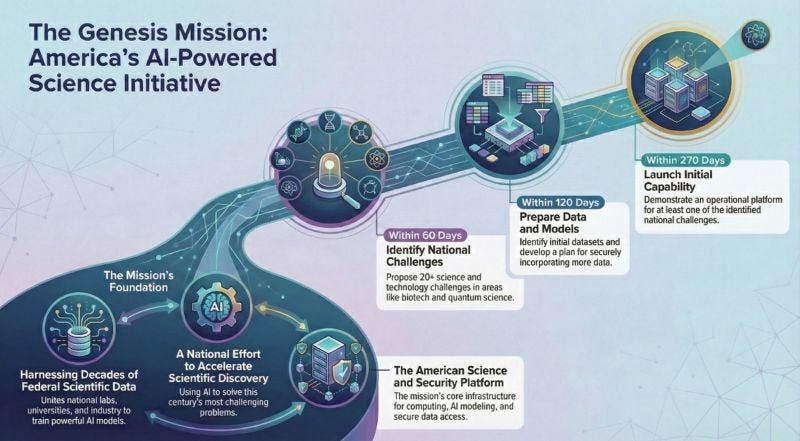
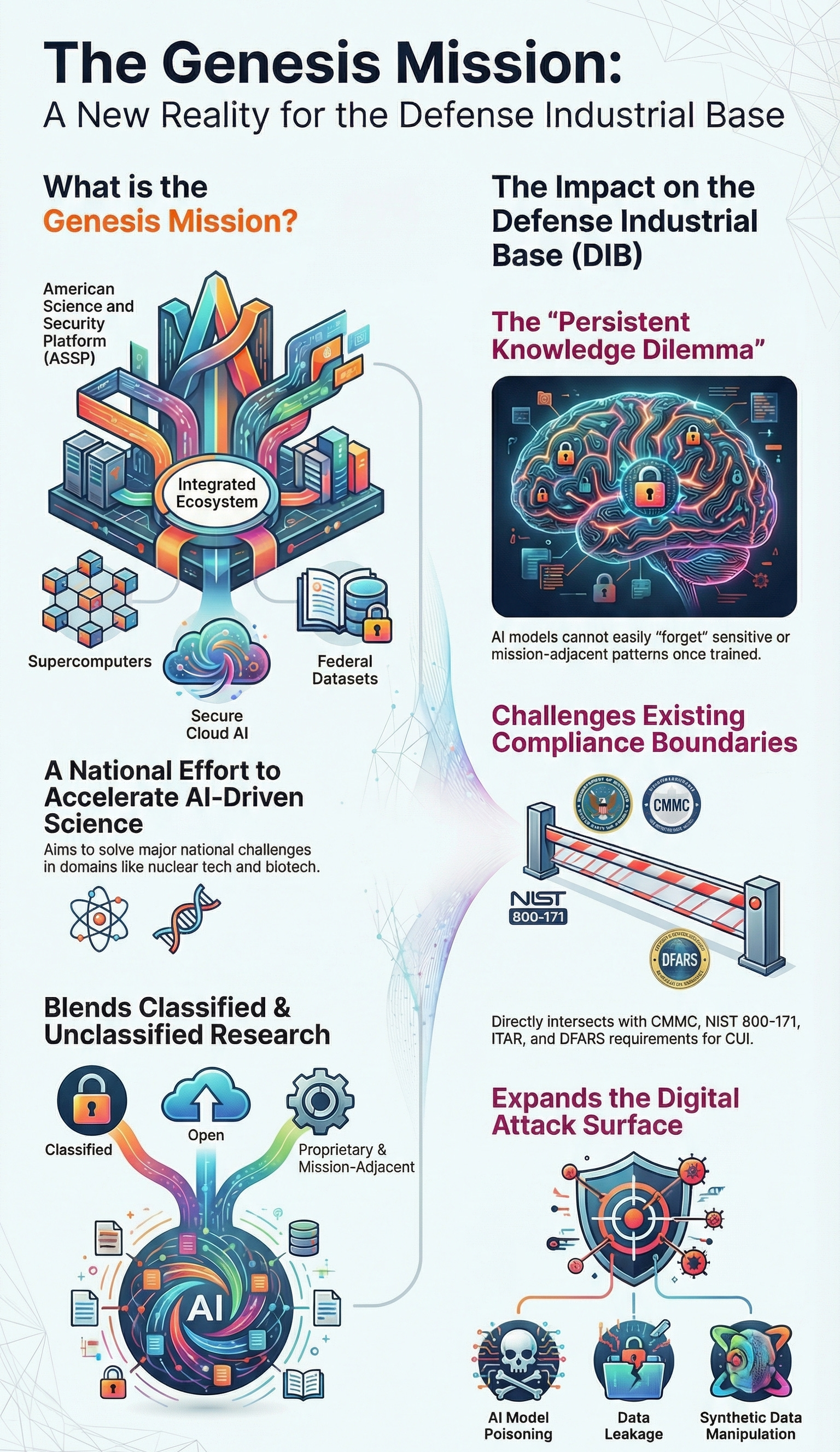
At the center of this initiative is the American Science and Security Platform, a unified national AI infrastructure integrating:
-
High-performance computing: DOE supercomputers and secure AI cloud environments.
-
AI modeling frameworks: agents capable of hypothesis generation, simulation, and workflow automation.
-
Scientific foundation models: domain-specific models trained across biology, materials science, physics, climate, and more.
-
Secure data access: integration of proprietary, federal, academic, and synthetic datasets under strict governance.
-
Robotic labs and AI-driven manufacturing: facilities capable of autonomous experimentation.
This is not merely a research platform. It is an attempt to build a federal AI operating system that spans data, compute, experimentation, and industrial translation.
The goal is clear: enable science to proceed at a pace dictated by the capabilities of AI systems rather than by traditional human-limited research cycles.
3. A New Model of Scientific Discovery
The Order envisions a research ecosystem where AI-augmented discovery becomes the default, not the exception. Key conceptual elements include:
-
AI agents as scientists: capable of exploring design spaces, testing hypotheses, interpreting experimental outcomes, and optimizing processes.
-
AI-directed experiments: robotic laboratories performing continuous cycles of testing and refinement.
-
Integrated datasets: standardized and governed for cross-domain model training.
-
Simulation-based science: foundation models generating synthetic data and accelerating model building.
This is aligned with a broader shift in global science toward closed-loop autonomous research pipelines. The Genesis Mission formalizes and federalizes this trend.

4. National Challenges and Strategic Priorities
Within 60 days, the Department of Energy must identify at least 20 national science and technology challenges. Priority domains include:
-
Advanced manufacturing
-
Biotechnology
-
Critical materials
-
Nuclear fission and fusion
-
Quantum information science
-
Semiconductors and microelectronics
These areas reflect long-term vulnerabilities in the American industrial and technological base. Addressing them through AI-accelerated research signals a strategic attempt to rebuild industrial self-reliance.
The Mission’s success will depend on choosing challenges where:
-
Data is available
-
Outcomes have economic or security relevance
-
AI models can meaningfully outperform traditional research methods
5. Interagency Coordination and the Role of External Partners
The Order acknowledges that federal fragmentation is a major barrier. Therefore:
-
The National Science and Technology Council becomes the central coordination body.
-
Agencies must align their AI programs and datasets.
-
Private sector partnerships become essential to achieve scale and innovation speed.
Notably, the Order mandates:
-
Standardized partnership frameworks
-
IP and commercialization policies
-
Uniform cybersecurity requirements
-
Strict user vetting and export-control safeguards
This structure aims to avoid repeating the disorganized decentralization seen in past U.S. AI initiatives.
The Genesis Mission thus becomes a federal anchor around which private academia, startups, hyperscalers, and defense contractors will orbit.
6. Timelines, Deliverables, and Metrics of Success
The Executive Order includes unusually aggressive deadlines. Within:
-
60 days: list of national challenges
-
90 days: identification of computing resources
-
120 days: initial data and model asset inventory
-
240 days: review of robotic lab capabilities
-
270 days: demonstration of an initial operating capability
-
1 year: full progress report to the President
The presence of clear timelines suggests an intention not only to build infrastructure but to produce measurable outcomes quickly, possibly before the next federal budget cycle.
Metrics will include:
-
Platform operational status
-
Integration across laboratories
-
Publications and breakthroughs
-
Private sector collaborations
-
Prototype technologies emerging from AI-directed experiments
This is a performance-driven approach rarely seen in federal science policy.
7. Strategic and Geopolitical Significance
The Genesis Mission reflects a broader realignment in global AI geopolitics.
China is currently pursuing integrated AI science platforms, national supercomputers, and state-directed fusion of data, compute, and industrial strategy.
The EU, although strong in regulatory frameworks, lacks equivalent computational concentration.
The United States is now explicitly responding with a federal initiative that combines industrial policy and AI-enabled science.
The Manhattan Project analogy is telling: the Order frames scientific acceleration as essential for national security. In this context, the Mission serves multiple functions:
-
Reinforcing semiconductor and microelectronics sovereignty
-
Accelerating energy innovation, including nuclear and fusion
-
Strengthening biodefense through AI-enhanced bioscience
-
Securing dominance in generative and scientific foundation models
The outcome will influence not only global AI leadership but the structure of twentieth-first-century industry.
8. Risks and Open Questions
Despite its ambition, the Genesis Mission faces several challenges:
-
Integration of fragmented federal datasets is complex and politically sensitive.
-
Cybersecurity requirements will slow cross-agency interoperability.
-
Private partners may resist standardized IP frameworks.
-
The scale of compute required could exceed current DOE capacity.
-
The initiative presupposes that scientific foundation models will reliably accelerate discovery, a claim not yet universally proven.
The mission’s success will depend on balancing national security constraints with the openness required for scientific progress.
Conclusion
The Genesis Mission is a transformational moment in U.S. science and technology policy. It establishes AI as a national strategic asset and builds an integrated platform designed to accelerate discovery, strengthen security, and rebuild industrial capacity. If executed effectively, it could redefine how science is conducted and restore American leadership in the technologies that shape global power. Yet its ambition brings substantive coordination, infrastructure, and governance challenges. The next 12 months will determine whether this initiative becomes a landmark success or another unrealized vision of technological mobilization.
For the full details: Genesis Mission